Gospel Notes by Michael Whelan SM
Today’s Gospel is taken from Luke 24:1-12
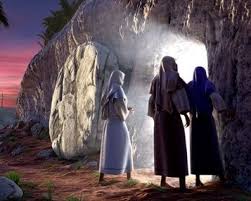
But on the first day of the week, at early dawn, they came to the tomb, taking the spices that they had prepared. They found the stone rolled away from the tomb, but when they went in, they did not find the body. While they were perplexed about this, suddenly two men in dazzling clothes stood beside them. The women were terrified and bowed their faces to the ground, but the men said to them, “Why do you look for the living among the dead? He is not here, but has risen. Remember how he told you, while he was still in Galilee, that the Son of Man must be handed over to sinners, and be crucified, and on the third day rise again.” Then they remembered his words, and returning from the tomb, they told all this to the eleven and to all the rest. Now it was Mary Magdalene, Joanna, Mary the mother of James, and the other women with them who told this to the apostles. But these words seemed to them an idle tale, and they did not believe them. But Peter got up and ran to the tomb; stooping and looking in, he saw the linen cloths by themselves; then he went home, amazed at what had happened (Luke 24:1-12 – NRSV).
Introductory notes
General
Today’s text is made up of the first 8 verses of the 53 verses in the final chapter of Luke’s Gospel. This chapter, taken as a whole, gives dramatic closure to the narrative Luke has been outlining for us in the previous chapters. He highlights some key themes:
- the confusion and misunderstandings of the disciples;
- Jesus as teacher interpreting the Scriptures;
- enabling the disciples to eventually see the truth;
- the breaking of bread and sharing of hospitality over a meal; continuation by the disciples of Jesus’ ministry, especially on repentance and the forgiveness of sin.
“The concluding chapter of the Gospel thus brings closure to the narrative of Jesus’ life and ministry, not least by making sense—via a fresh reading of Scripture through the lens of the passion—of his messianic vocation culminating in suffering and death. Even more prominently, in a way that is unique among the nt Gospels, the Easter story in Luke prepares for the continuation of the story in a narrative sequel (Acts). As the Gospel closes, significant narrative threads and expectations remain unrealized, especially (1) the full rehabilitation and Spirit-empowerment of the apostles, including the restoring of the full complement of the Twelve; (2) the response of Jewish people and leaders to their witness; (3) their mission to the nations and the opening up of God’s realm to Gentiles; and beyond the Acts narrative, also (4) the fall of Jerusalem and the temple’s destruction and (5) the eschatological return of Jesus.
“In tandem with Acts 1, then, Luke 24 builds a bridge from the mission of Jesus to that of the disciple-witnesses, which will extend the work of Jesus—as with Jesus’ ministry, under the direction and empowerment of the Spirit—to the farthest reaches of the earth (cf. Green 832). This momentous transition begins with the return of women disciples to the tomb, to complete the burial rites that will honor their deceased Lord” (J T Carroll, Luke: A Commentary, C. C. Black & M. E. Boring, Eds. (First Edition), Louisville, KY: Westminster John Knox Press, 2012, 474-475).
As regards the 8 verses of our text today:
All four Gospels situate the resurrection at dawn “on the first day of the week” – see Mark 16:2, Matthew 28:1 and John 20:1. All make reference to “the rolling away of the stone”.
However, Luke – unlike Mark 15:46 (“Then Joseph bought a linen cloth, and taking down the body, wrapped it in the linen cloth, and laid it in a tomb that had been hewn out of the rock. He then rolled a stone against the door of the tomb. Mary Magdalene and Mary the mother of Joses saw where the body was laid.”) – does not mention the stone at this stage. He simply says: “Then (Joseph of Arimathea) took (the body) down, wrapped it in a linen cloth, and laid it in a rock-hewn tomb where no one had ever been laid. It was the day of Preparation, and the sabbath was beginning. The women who had come with him from Galilee followed, and they saw the tomb and how his body was laid. Then they returned, and prepared spices and ointments” (Luke 23:53). Accordingly, Luke makes no mention of the women, as they approach the tomb with their spices, wondering how they are going to move the stone.
All four Gospels say that women were the first to discover and announce the resurrection. Luke alone specifies that these were “the women who had come with him from Galilee” (23:55). Luke names three of those women: “Mary Magdalene, Joanna, Mary the mother of James”. The first of the three named by Luke is the only one named by all four Gospels.
A particular feature of Luke is the unwillingness of the disciples to believe. Even when Peter had gone to see the empty tomb, he was “amazed” but not yet a believer. Joseph Fitzmyer writes: “(T)heir testimony does not engender faith; it does not give ‘assurance’ (asphaleia). The Lucan story even singles out the ‘apostles’ as the ones who discredit the report. Their faith will have to depend on their own seeing (see Acts 1:22). Peter alone of them is aroused, but only to curiosity; he goes off to see for himself, and comes home ‘wondering about what had happened’ (v. 12), not yet believing. That will take an appearance of the risen Christ, about which we learn in v. 34” (Joseph A Fitzmyer, S. J., The Gospel according to Luke X–XXIV: introduction, translation, and notes, (Vol. 28A), New Haven; London: Yale University Press, 2008, 1543).
Fitzmyer sums up: “The purpose of this episode, which centers on the praeconium paschale, is to present Jesus as the victor over death. Through his ‘suffering’ he has become the risen Christ and Lord (see Acts 2:36); he has passed from the status of earthly teacher and healer to the exalted Son, who will pour forth the ‘promise of my Father’ (Acts 1:4; cf. 2:33) on all those who will know him in the breaking of the bread. Death no longer holds him in its grip. In this episode we witness how difficult it was for even dedicated followers to comprehend his victory over death. This difficulty will become even more evident in the following episodes, when the risen Christ manifests himself to such persons and only gradually comes to be recognized by them for what he is. The words addressed to the repentant criminal now take on meaning: ‘Today you shall be with me in Paradise’ (23:43). As the victor over death, Jesus has indeed come into his kingdom. A share in it awaits the faithful disciple who recognizes him now as the risen Lord” (Joseph A Fitzmyer, op cit, 1543).
Specific
But on the first day of the week: Today’s Gospel begins with a contrast statement. In the previous verse – see Luke 23:56 – we are told: “On the sabbath they rested according to the commandment”. One commentator notes: “Then comes the contrast (note the μέν … δέ construction) on the first day of the week …. The same phrase is used in all four Gospels, even down to the use of μία (cardinal number for ordinal …) but is on occasion due to Semitic influence …. But it was no doubt a stereotyped usage for Sunday (Acts 20:7; 1 Cor. 16:2; Jn. 20:19” (I H Marshall, The Gospel of Luke: a commentary on the Greek text, Exeter: Paternoster Press, 1978, 883).
“Following the Greco-Roman reckoning of time, in which evening concludes the day rather than beginning the next day, as in Jewish temporal figuring (see van Tilborg and Counet, Appearances 31–32); the narrator provides specific time markers in 24:1, 13, 29, 33 that locate the events narrated on the same day, the ‘third day’ of Jesus’ prophecy (9:22; 18:33; see Dillon, Eye-Witnesses 181); specific time indicators are lacking, however, in vv. 50–53” (J T Carroll, op cit, footnote on 474).
They found the stone rolled away from the tomb: Archaeologists have found a number of tombs in the vicinity of Jerusalem, dating from the 1st century, “fitted with huge circular stone discs that were set in a transverse channel hollowed out of stone, along which the discs would be rolled in front of a rectangular doorway opening on to the tomb proper. As one faced the doorway from the outside, the stone would be rolled from left to right (or vice versa) to open or close the tomb” (Joseph A Fitzmyer, op cit, 1544).
two men in dazzling clothes stood beside them: We remember the event in which Jesus is transfigured – see Luke 9:30. We also remember the context of that event – the first prophecy of the passion (9:22) is followed by a stark description of the conditions for following Christ (9:23-26) which is followed by the enigmatic statement that “there are some standing here who will not taste death before they see the kingdom of God”. The transfiguration is then described. The two on the road to Emmaus tell Jesus that the women did not find the body and that they had seen “a vision of angels” – see 24:23.
The women were terrified: Luke uses the adjective emphobos (terrified). Mark uses the nouns tromos (trembling) and ekstasis (astonishment) – see 16:8. Matthew has a more dramatic description: “Suddenly there was a great earthquake; for an angel of the Lord, descending from heaven, came and rolled back the stone and sat on it. His appearance was like lightning, and his clothing white as snow. For fear (the noun phobos) of him the guards shook and became like dead men. But the angel said to the women, “Do not be afraid (the verb phobeō); I know that you are looking for Jesus who was crucified” (28:2-5).
an idle tale: The Greek word is lēros. Most English versions use this translation. But Fitzmyer explains the Greek expression used by Luke to describe the reception the disciples gave to the women’s news of the empty tomb in the following way: “they treat the report of the women hōsei lēros, ‘as if (it were) humbug’” (Joseph A Fitzmyer, op cit, 1547). The Greek word might also be translated as “nonsense”.
Neither Matthew nor John have any of this description of the disciples not believing the women. Mark’s first ending has the women telling no one – see Mark 16:8. The text that was added to Mark later – 16:9-20 – does include a reference to the disbelief of the disciples but not with the emphasis given by Luke.
The meaning of the resurrection
Today’s Gospel – Luke 24:1-12 – tells of two extraordinary historical facts. The first is the resurrection of Jesus. The second is the transformation of those who found in his resurrection the fulfilment of God’s Covenant. The first fact is obviously crucial: Jesus rose from the dead. But the second is a necessary instrument of the first: The disciples are transformed by this fact. Mere belief in the resurrection does not make us Christian. Being transformed by the resurrection does make us Christians.
N T Wright, in his scholarly work, The Resurrection of the Son of God (Fortress Press, 2003) writes: “The Jewish writer Pinchas Lapide has declared that he believes Jesus of Nazareth was bodily raised from the dead. Indeed, he believes this far more solidly than many would-be Christian theologians. But this belief does not make him a Christian. For him, the resurrection does not ‘mean’ that Jesus is in any sense, whether messianic or divine, the ‘son of God’. Rather, it means that he was and is a great prophet to whom Israel should have paid attention at the time” (page 721).
Luke’s account of those first disciples discovering the empty tomb tells of something radically different. The meaning they grasp on that “first day of the week” is explosive. It is not a matter of assent to a proposition. It is rather the experience of a fact of history that changes everything for them. They are transformed. They become different people because of that experience. History is changed as a consequence!
This raises a question: Is our belief in the resurrection closer to that of Pinchas Lapide or of those first disciples? We could put the question in another way: Is the presence of the risen Lord a transforming fact in my days, or just a proposition that I believe? What does it mean for me when I say in the Creed: “The third day he rose again from the dead”?
Our faith is imbued with and enlivened by the living presence of Jesus. Or it is not. We are Christian because we live out our lives in communion with the Risen Lord, because that means more than anything to us. This will manifest itself in certain doctrinal statements and moral imperatives. But these are nothing if they do not express a lived and living reality.
Very early in the Christian Tradition, there developed the ritual gathering that became known as the Eucharist. Eucharist was and remains an event in which believers share his life, his real presence. When the Gospel is proclaimed in those gatherings, the proclaimer greets the people who return the greeting. He then announces the Gospel, and the people respond, “Glory to you, Lord!” Having proclaimed the Gospel, the people acknowledge the presence of the Risen Lord: “Praise to you, Lord Jesus Christ!” We do well to listen carefully to these and other words and rituals within the Eucharist. They tell of his presence.